
How AI Is Transforming Communications Strategy for Canadian SMBs
On June 4, 2026, Prime Minister Mark Carney launched "AI for All", Canada's new national AI strategy with a $500M investment aimed at raising the country's AI adoption rate from 12% to 60% by 2034. For SMBs and professional firms, the message is clear: artificial intelligence is no longer a technology trend reserved for tech giants.


AI is becoming a concrete competitive advantage in business communications. Yet most Canadian business leaders don't know where to start, or how to leverage AI without sacrificing their expert voice and hard-earned reputation. This article gives you a clear, actionable roadmap.
Why are Canadian SMBs falling behind on AI adoption in communications?
According to MNP Digital's 2026 report, only 12% of Canadian SMBs have adopted AI in their operations, versus 26% in Germany and 29–42% in Nordic countries.
Despite the federal "AI for All" strategy, a real gap remains on the ground. The main barriers among SMBs and professional firms (law, accounting, consulting) include:
Concerns about data privacy and confidentiality
Lack of internal resources to test and implement tools
Fear of sounding generic or losing expert credibility
The reality: it's not AI that threatens your reputation, it's the absence of a strategy around its use.
How can AI strengthen, not replace, your media relations?
A 2025 Cision study, State of the Media, found that 86% of Canadian journalists report receiving poorly targeted pitches. AI tools can analyze editorial interests in real time to help craft sharper, more relevant pitches.
AI can help you:
Monitor media coverage of your industry and competitors Identify the most relevant journalists and outlets for your announcements;
Draft pitch angles tailored to individual editorial profiles; and
Track your online reputation with personalized alerts.
But proceed with caution: an AI-generated press release that hasn't been reviewed by a communications professional is a reputational risk. Human judgment, strategic framing, and journalist relationships remain irreplaceable.
AI and reputation management: how to respond faster in a crisis?
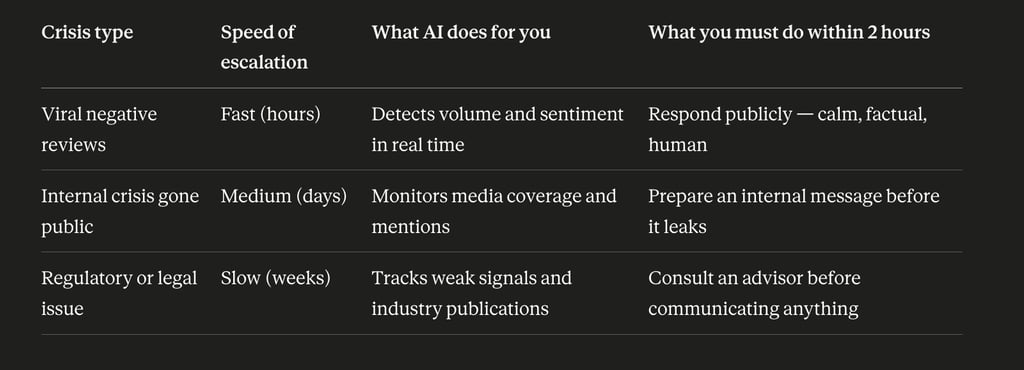
AI is transforming crisis communications by enabling real-time monitoring. Tools like Brand24, Mention, or Cision's AI modules can detect a reputational issue before it goes viral, a critical intervention window for any professional firm or public-facing SMB. But detection alone isn't enough. The real value of AI in crisis management is helping you decide what to do, and how fast, based on the nature of the issue.
What type of crisis? What response?
The winning approach: pair automated AI monitoring with the judgment of a communications advisor — especially when pressure is mounting.
What concrete steps can you take now to integrate AI into your communications strategy?
Canada's "AI for All" strategy projects 250,000 new AI-related jobs over the next five years, a transformation that will directly shape how organizations communicate.
A practical starting point for SMB leaders:
Start with monitoring: use an AI tool to track your brand mentions and competitor activity
Optimize existing content: audit past articles, press releases, and posts to identify positioning gaps
Train your team or bring in an expert: AI is a lever, not a shortcut, and the tool doesn't replace human judgment.
FAQ
Can AI write professional press releases?
AI can generate a solid first draft, but a communications professional must always review tone, angle, and reputational risks before distribution.
Is my company too small to benefit from AI in communications?
No. Even a 10-person SMB can use accessible AI tools to monitor reputation, optimize web content, and sharpen key messaging.
How do I protect client confidentiality when using AI?
Avoid entering sensitive data into public tools. Choose platforms with clear privacy policies and consider Canadian-hosted solutions when possible.
Marion's Conclusion
Canada's "AI for All" strategy confirms that artificial intelligence is no longer optional, it's structural. But its effectiveness in communications depends on one thing: the clarity of your strategy before the tool. Start small, measure impact, and surround yourself with expert counsel to avoid costly reputational mistakes.
For hands-on, brilliant communication, that's Marion.